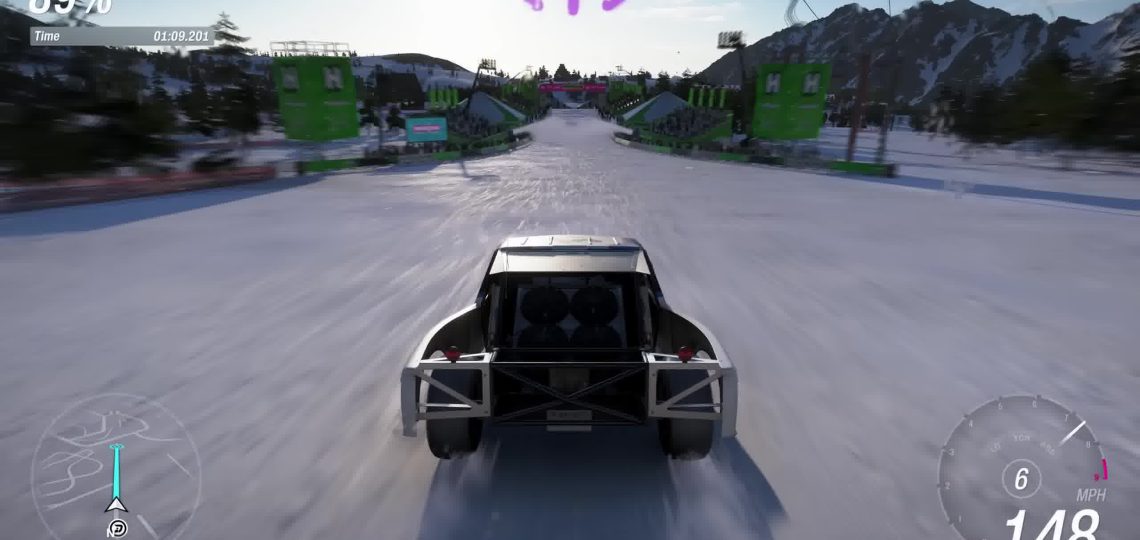
Forza Horizon 6 – Japan Widebody Challenge Breakdown & Multiplayer Race Analysis
The opening event of Forza Horizon 6 immediately establishes its identity: chaotic progression, build creativity under constraint, and loosely structured competitive multiplayer across Tokyo-style urban roads and scenic Japanese mountain routes. The session revolves around a “widebody A-Class” restriction followed by a sequence of mixed discipline events—navigation racing, drag, circuit, drift, and free-form skill checks.
What makes this particular run notable is not just the car variety, but the way imperfect information (no map usage, unclear routes, partial event unlocks) forces adaptive driving decisions.
Core Event Structure Overview
The entire session unfolds as a chained playlist of improvisational challenges:
| Stage | Event Type | Core Constraint | Key Skill Tested |
| 1 | Widebody Selection Build | A-Class upgrade only | Build optimization & creativity |
| 2 | Free Roam Navigation Race | No map / no waypoint | Spatial awareness |
| 3 | Drag Race (Quarter Mile) | Straight-line tuning | Launch control & traction |
| 4 | Circuit Race | Standard race | Cornering + consistency |
| 5 | Time Attack | Solo lap performance | Clean lap execution |
| 6 | Drift Zone | Score-based drifting | Slide control |
| 7 | Long Jump (Ski Jump) | Danger sign style jump | Speed + stability |
| 8 | Top Speed Test | Open highway sprint | Terminal velocity tuning |
Widebody Build Meta Snapshot
The opening challenge forces players into a single decision: choose a widebody vehicle and push it into A-Class without clear meta guidance. This leads to highly divergent builds:
| Player Archetype | Car Choice Style | Performance Outcome |
| JDM Risk Build | Lightweight Japanese platforms | High inconsistency |
| Power Build | Higher horsepower AWD/FWD swaps | Strong straight-line |
| “Meme Build” | Unconventional cars (e.g., Kei-style) | Low competitive viability |
| Balanced Build | Moderate weight + handling focus | Most consistent |
A recurring issue is drivetrain mismatch—particularly high-power front-wheel-drive setups causing wheelspin and unstable launches during drag segments.
Free Roam Navigation Race – Tokyo Chaos Simulation
The first major race removes navigation assistance entirely, creating a real-world routing problem inside a dense urban environment.
Observed Dynamics
- Players split immediately into multiple routing strategies
- Highway vs inner-city routing divergence creates massive time gaps
- Shortcut discovery (notably highway exits and illegal cuts) becomes decisive
| Strategy | Risk Level | Result Efficiency |
| Highway Route | Low risk | Moderate speed |
| City Cut Routes | High risk | High reward |
| Hybrid Routing | Medium | Best overall consistency |
A key insight: shortcut exploitation outweighed raw car performance in determining early positioning.
Drag Race – Quarter Mile Execution
The drag race exposed tuning imbalance more than driver skill.
| Factor | Impact |
| Wheelspin control | Critical failure point |
| AWD conversion | Stability advantage |
| Gear tuning | Determines launch consistency |
| Tire compound | Direct traction multiplier |
Front-wheel-drive setups suffered significantly, especially when paired with high horsepower builds lacking traction optimization.
Circuit Race – Corner Discipline Check
This segment introduced full-track racing on a scenic Japanese circuit with mixed technical corners.
Key Observations
- AWD vehicles maintained superior corner exit stability
- FWD builds required heavy braking compensation
- Sport vs rally tire selection drastically changed handling behavior
| Tire Type | Strength | Weakness |
| Sport | Balanced grip | Moderate slide under pressure |
| Semi-Slick | High grip | Reduced forgiveness |
| Rally | Stability on rough surfaces | Reduced asphalt corner speed |
Driver error became more impactful than raw car performance in this stage.
Time Attack – Performance Compression Test
Time attack created the first clear leaderboard separation due to isolated lap conditions.
| Player | Approx. Best Lap |
| DJ | ~0:56 (dominant pace) |
| Nathan | ~0:59 |
| Jack | ~1:03 |
| Others | ~1:05+ |
This stage revealed a widening skill gap, especially in corner exit optimization and braking discipline.
Drift Zone – Control vs Power Tradeoff
Drift scoring exposed a structural imbalance between grip builds and drift-capable setups.
- AWD builds could initiate drifts but struggled with sustained angle
- RWD-style setups performed significantly better in scoring consistency
- FWD builds required aggressive handbrake dependence
| Setup Type | Drift Score Potential |
| RWD Drift Build | High |
| AWD Hybrid | Medium |
| FWD Grip Build | Low |
Long Jump (Ski Jump) – Physics Stress Test
The ski jump segment highlighted how suspension tuning and drivetrain behavior affect airborne stability.
| Build Type | Jump Distance |
| Lightweight AWD | Moderate |
| Heavy AWD | High momentum but unstable |
| Rally Tire Setup | Inconsistent traction on approach |
Unexpectedly, some rally tire setups underperformed due to reduced runway traction.
Top Speed Test – Highway Terminal Velocity
The final free-form test focused on sustained top-end performance.
Key performance factors:
- Gear ratio optimization
- Drag coefficient from widebody kits
- Engine swap selection
High-power builds dominated, but only when traction losses were minimized during acceleration phases.
Overall Standings Summary
The cumulative scoring produced a clear tier separation:
| Rank | Player | Points |
| 1 | DJ | 11 |
| 2 | Jack | 5 |
| 3 | Narrator (Player) | 4 |
| 4 | Kimmy / Geek | 1 |
| 5 | Wrecker | 1 |
DJ’s consistency across every discipline was the defining factor, while others fluctuated heavily based on event type specialization.
Economy & Progression Layer (FH6 Credits Context)
As progression systems expand, vehicle experimentation becomes increasingly tied to resource availability. Players consistently noted that unlocking diverse builds requires efficient allocation of FH6 Credits across tuning, upgrades, and car acquisition.
In practical terms, players seeking faster experimentation loops often prioritize strategies around buy Forza Horizon 6 Credits, enabling immediate access to meta-relevant platforms instead of incremental progression grinding.
Systemic Observations on Multiplayer Stability
Despite occasional desync and leaderboard inconsistencies:
- Race syncing was generally stable in real time
- Lap time visibility occasionally failed across clients
- Navigation races amplified network divergence due to route randomness
The system remains functional but shows stress under multi-event rapid transitions.
Progression Takeaways
This opening FH6 challenge set establishes three dominant truths about the game’s current meta environment:
- Build diversity matters more than raw performance in mixed playlists
- Navigation-based events introduce a new strategic layer beyond racing lines
- Early economy pressure makes credit allocation and car access a defining progression constraint
The session ultimately positions Forza Horizon 6 as less of a pure racing sandbox and more of a hybrid system combining route optimization, build theorycrafting, and adaptive multiplayer decision-making under uncertainty.